Thursday, October 8, 2009

Iranian Navy & Marine Exercises on the Caspian Sea

Iranian Navy and Marine Exercises at Nowshahr, October 6, 2009.
(click to enlarge photos)

Background:
P225 Joshan Kaman (Sina) class fast attack/patrol missile boat.
P223 Khadang Kaman class fast attack/patrol missile boat.
Foreground:
IRIN Agusta-Bell AB 212.

IRIN Agusta-Bell AB 212 deploying Naval Special Warfare team.

IRIN Sikorsky SH-3D Sea King deploying Iranian Marines.

IRIN Agusta-Bell AB 212 deploying Iranian Marines.

Iranian Marine rifle and motorized RPG teams take up defensive beachfront positions.

Wednesday, October 7, 2009

Heightened Security: Khamenei's Praetorian Guard

(click to enlarge)
Inspection of the officer cadet graduating class of 2009, at the Imam Khomeini Naval Sciences University in Nowshahr. Note the phalanx of burly-sized, armed security guards protecting supreme leader Ayatollah Khamenei at all times during the ceremony. This may very well be a protective measure now in place since the post-election political dispute. The sidearms carried by the security guards appear to be large calibre service revolvers. Above photo depicts an escorting security detachment of four guards, while the photo below shows a total of six guards, including a plain-clothes team leader. At least seven different guards can be identified between the two photos.
(click to enlarge)
It's interesting to see Iran's top ranking military officials so frequently assemble itself in one public place. The Commander-in-Chief is present, together with all the heads of the respective military branches, including the Defense Minister. They did this in September and now again in October. During times of heightened regional tension, and with it the threat posed by long-range drone attack aircraft, one really must wonder if this is such a wise idea. Perhaps a constant political need for public displays of military solidarity simply outweighs the potential risk.

--MARK PYRUZ

Brigadier General Naqdi: New Basij Commandant

Brigadier General Mohammad Reza Naqdi was born in Najaf, Iraq in 1953. He and his family were expelled from Iraq during Saddam's mass purge of Iranians in 1980. Later, he enlisted in the Basij Expeditionary Force, saw action in Lebanon and was closely linked to Hezbollah. Upon returning to Iran, he became a member of the Supreme Iraqi Islamic Revolution Council. (The term "Revolution" was later omitted in 2007.)

Around 1993, Iran's supreme leader Ayatollah Khamenei employed Naqdi as a rising intelligence officer for the IRGC Quds Force. Shortly thereafter, Naqdi was posted at the Intelligence office of Iran's security, to be subsequently assigned into a high ranking staff position as a Brigadier General at General Command Headquarters.

In 1999, during Khatami's presidency, Naqdi participated in a semi-coup against the freely elected reformist government. He was instrumental in arresting the mayor of Tehran, Gholamhossein Karbaschi, together with 164 top municipal employees. He was also involved in plotting assassination attempts against Abdullah Nouri (Interior Minister) and Mohajerani (Minister of Islamic Culture and Guidance), and played a key role in coordinating a crackdown against a student uprising at Tehran University by members of Ansar Hezbollah, a plain-clothed militia that along with others, Naqdi played a key role in organizing and financing.

In 2000, Naqdi formed a political group called called the Band-e Kabir (Great Gang) to "prevent social corruption". Breaking Iranian law in the process, he faced charges of criminal activity in judicial proceedings and was sentenced to a 3 month prison term, which he never served. Naqdi is rumored to have been involved (together with Mohseni Ejei- Ahmadinejad's minister of Intelligence) with the suspicious death of the judge that handled the Tehran mayor's criminal case (the judge suffered cardiac arrest apparently due to air-injection).

It's interesting to note that the members of Band-e Kabir were charged with several felonies (including kidnapping, extortion, use of dangerous weapons and firearms, as well as abuse of governmental power) and were publicly prosecuted. However Naqdi, who is closely connected within the Supreme Leader's inner circle, was spared. In fact, instead of being prosecuted, he was promoted by President Ahmadinejad in 2005 and put in charge of a federal corruption probe, the "Committee to Combat Drug and Currency Smuggling". Responding to Naqdi's exposure of smuggling practices by one of President Ahmadinejad's major financial supporters, Naqdi was removed from his anti-corruption post, to be returned to a staff position in the Iranian armed forces by the Supreme Leader.

On Sunday, October 4th, Ayatollah Khamenei appointed Naqdi as Basij Commandant, replacing cleric Hojjatoleslam Hossein Taeb. Naqdi's selection by the Supreme Leader indicates the need for a hard hitting, security minded authority, who is not afraid to take decisive action against internal elements perceived as a soft or hard threat to the Islamic Republic establishment. It's also possible that his appointment, to a degree, represents an attempt by Khamenei to promote a balance of power within Iran's multiple layers of state security apparatuses, with Naqdi very much being a supreme leader man. It has also been reported that the Basij are to be incorporated into IRGC ground forces and if true, Naqdi will no doubt supervise this formal crossover.

*Biography provided courtesy of Naj at Neo-Resistance, with supplemental details provided by Roozonline.com

--MARK PYRUZ

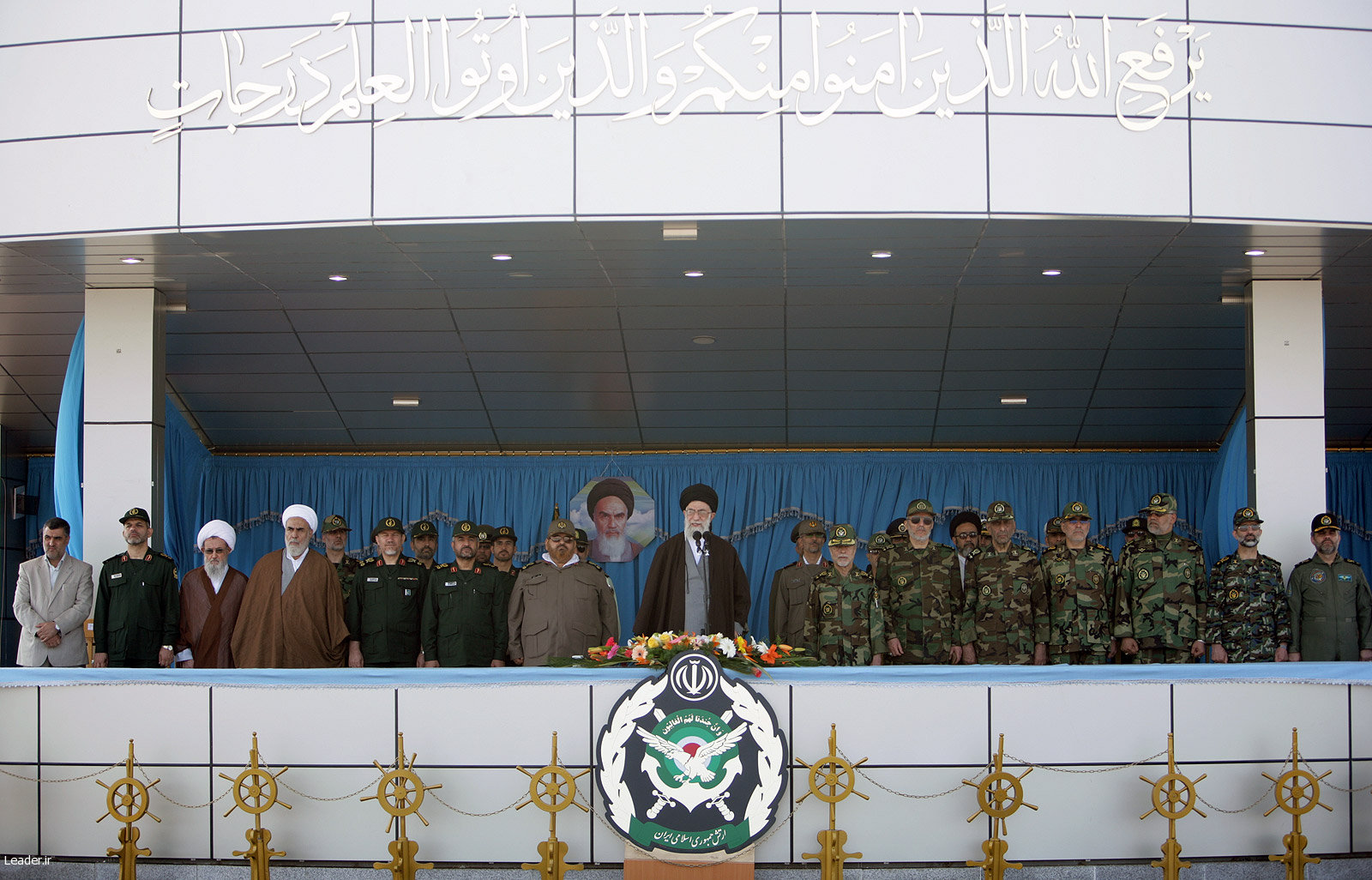
Commanders of the Islamic Republic - 10/09

On the parade grounds of Imam Khomeini Naval Sciences University in Nowshahr, October 6, 2009.
(Click to enlarge)
Front row, left to right:
- Unknown
- Brigadier General Ahmad Vahidi (Defense Minister)
- Grand Ayatollah Naser Makarem Shirazi (Cleric)
- Hojatoleslam Mohammad Golpayegani (Cleric- Ideological/Political Head of the Military)
- Major General Yahya Rahim-Safavi (Senior Advisor to the Leader of the Islamic Revolution)
- Major General Mohammad Ali Jafari (Commander-in-Chief of the IRGC)
- Major General Hassan Firouzabadi (Head of the Armed Forces General Command Headquarters)
- Supreme Leader Sayyid Ali Khamenei (Commander-in-Chief of the Armed Forces)
- Major General Ataollah Salehi (Commander-in-Chief of the Army)
- Major General (Army)
- Major General Mohammad Salimi (Army)
- Brigadier General (Army)
- Brigadier General Ahmad Reza Pourdastan (Commander of the Ground Force)
- Brigadier General Ahmad Mighani (Commander of Air Defense)
- Brigadier General Hassan Shah-Safi (Commander of the Air Force)

Second row, behind Maj. Gen. Jafari:
- Brigadier General Amir Ali Hajizadeh (Commander of IRGC Aerospace)
- Rear Admiral Morteza Saffari (Commander of IRGC Navy)

Rank conversions:
Brigadier General: Sartip (سرتیپ)
Major General: Sarlashkar (سرلشگر)
Commander-in-Chief: Farmandeye kole ghova (فرمانده کل قوا)

Note: Any corrections and additions greatly appreciated.
Ultra high resolution version of photo available at the Supreme Leader website.

Officer Service Dress Uniforms of Iran's Armed Forces

Photos from graduation oath-taking and epulet awarding of officer cadets, from military universities of the Islamic Republic of Iran's armed forces, on the field of Imam Khomeini Naval Sciences University in Nowshahr, October 6, 2009.
(click to enlarge)
Left to Right:
Army Major (Artesh Sargord سرگرد), Air Force Major (Sargord سرگرد), Navy Commander (Nakhoda dovom ناخدا دوم). Note lack of ties for all services, officer swords with fitted sword knots, bloused trousers inside black leather combat boots, heavy style lanyards (red-army, light blue-air force, gold-navy), embroidered hat visors, enamel ribbon bars and assorted military regalia. (Officers have each been presented with a gift from the Supreme Leader.)
(click to enlarge)
Left to right:
Army Colonel (Artesh Sarhang سرهنگ), Navy Captain (Nakhoda yekom ناخدا یکم), Navy officer. Army Colonel wears double breasted service dress coat and dress shoes. Navy Captain wears new style single breast white tunic with heavy gold lanyard and white officer's shoes. Navy officer at right appears to be wearing older style white tunic, with white leather Sam Browne belt and attached saber sling, and bloused trousers inside white leather combat boots.
(click to enlarge)
Front row, left to right:
Navy Lt. Commander (Nakhoda Sevom ناخدا سوم), Air Force Colonel (Sartip dovom سرتیپ۲), Air Force Colonel, Navy Captain (Nakhoda yekom ناخدا یکم)- note lack of shoulder insignia, Air Force Colonel.
Right-side photo:
Navy Ensign (Navban dovom ناوبان ۲) wearing dress blue double breasted coat, with heavy gold lanyard and shoulder cord.
(click to enlarge)
Graduating officer cadets of the IRIAF, IRIA and IRIN.

Note: Any corrections and additions greatly appreciated.

Many additional ultra high resolution images available at:

Monday, October 5, 2009

Khamenei Reshuffles IRGC & Basij Commanders

Iran's supreme leader Ayatollah Ali Khamenei on Sunday issued decrees reshuffling several commanders in the elite Islamic Revolutionary Guards Corps (IRGC) and Basij (volunteer mobilization) forces, official media reported.

Reports in all state media state that Brigadier General Mohammad Reza Naqdi (left), a veteran Basiji, has replaced cleric Hojjatoleslam Hossein Taeb (right) as commander of the Basij. Taeb has been reassigned to a posting with the IRGC. There are reports the Basij force will be merged into the IRGC ground forces, for better coordination.

Brigadier General Mohammad Hejazi (left) has been appointed commander of the Logistics of the Joint Chiefs of Staff, replacing Naqdi, media reported. Brigadier General Hossein Salami (right), commander of the Guards' air force, has been promoted to deputy commander of the Revolutionary Guards, the post previously held by Hejazi.

The new commander of the Revolutionary Guards air force is Brigadier General Amir Ali Hajizadeh.

Sunday, October 4, 2009

Site Addition: Iran Military Studies Reading List


There's a new addition to this blog site: an Iran Military Studies Reading List. It can be found on the right-hand side of the blog page by scrolling down below Iran Military Photo/Video Galleries II. Included are monographs and book titles. Monographs are linked to PDF or web pages. Book titles contain links to Google book previews. Modern Iranian military themes are included, as well as aviation and military history.

Saturday, October 3, 2009

RAND Report: The Rise of the Pasdaran (IRGC)


RAND report: The Rise of the Pasdaran by the National Defense Research Institute (PDF)

Recommended reading, especially in light of the pre-election / post-election power struggles taking place in Iran. Monograph provides an assessment of the domestic roles of Iran's Islamic Revolutionary Guards Corps. Published 2009.

Saudis to get Russian missiles instead of Iran?

Iran: No Deals with P5+1 at Geneva Talks

Mehr News and PressTV are now reporting that no deal was reached during the Geneva talks regarding Iran shipping its domestically low-enriched uranium stock to Russia for further refinement.

Press TV reports today that Iran's Supreme National Security Council said the assumption that such an agreement had been reached with the P5+1 (permanent members of Security Council plus Germany) during the Geneva talks was untrue. The Council's Media Secretary Peyman Jebelli made the announcement in an interview with Press TV.

Earlier, on Oct. 2nd, Mehr News reported that a member of the Iranian delegation who attended the Geneva talks on Thursday said no agreement was made on delivering Iran’s 5 percent enriched uranium to one of the 5+1 countries and receiving 20 percent enriched uranium.

Mehr further reported that the negotiator, who spoke to the Mehr News Agency on condition of anonymity, said no consensus was made about inspection of the Fordoo nuclear project near Qom in two weeks.

Both news agencies are reporting that the issue of supplying Iran with medium-enriched uranium and the inspection date for the Qom enrichment site will be topics of discussion at a meeting between the IAEA and Iran on Oct. 18. They also state that this was prearranged before Iran's meeting with the P5+1 group in Geneva, Switzerland.

Analysis:
The Iranians may be emphasizing the fact that nothing was actually finalized at the Geneva Talks 2 Forum. The medium-enrichment proposal in Russia may be something put on the table that the Iranian negotiators agreed to pursue "in principle".

However, the declarations in Iran's news media may also signal that the Iranian decision makers have now had a chance to study the contents of the Geneva talks, and based upon this have drawn up more calculated positions on the issue of MEU and the Qom inspection schedule.

It probably hasn't helped any that Western government and media sources are openly depicting the medium-enrichment proposal in Russia as the means of purposely withdrawing Iran's LEU stock, in order to deny it the supposed ability of producing a nuclear weapon. This gives the impression of a "hostage-like" situation in the making, which could serve to undermine Iran's position in nuclear discussions, as well as set back its civilian nuclear program. Likewise, the Qom nuclear site inspection is also being depicted as a P5+1 "demand", when in reality it involves the IAEA and Iran exclusively. The Iranians appear sensitive to such depictions, which more often than not have the effect of influencing their positions on diplomacy.

--MARK PYRUZ

IAEA Chief in Tehran

Mohamed ElBaradei
ISNA/AFP Photo

Mohamed ElBaradei, director of International Atomic Energy Agency, arrived in Tehran today for talks with Iranian officials on a timetable for IAEA inspectors to visit the newly disclosed Qum uranium enrichment facility.

Iran agreed with six major powers in Geneva on Thursday to allow IAEA inspectors unfettered access to the plant.

Iran had also agreed “in principle” on Thursday to ship out 1,200 kg of its inventory of 1,500 kg enriched uranium for reprocessing in Russia and France. It would then be returned to be used in a Tehran reactor that makes medical isotopes.

Friday, October 2, 2009

Iranian Optimism Over Geneva Talks 2 Forum

There was cause for Iranian optimism over its meeting with the P5+1 group in Geneva, Switzerland:

Iran's Request for Medium-Enriched Uranium Granted
Iran recently requested the IAEA provide it with enriched uranium to 19.75% for the Tehran research-medical reactor, which was furnished by the United States in 1968. The fuel for the reactor was provided by Argentina in 1993 and Iran said the fuel will run out by December 2010. (President Ahmadinejad informally solicited the US with this request during his visit to New York last week).

Today, in a surprise move the IAEA and P5+1 group proposed Iran's request be granted, by means of Iran providing domestically produced low-enriched uranium for further enrichment in Russia, to be turned into fuel rods in France. The meeting's delegates agreed in principle to this arrangement.

Significantly, this agreed upon arrangement implies Western acceptance of Iran's right to enrich uranium, representing a potential breakthrough for its long-held nuclear position.

Saeed Jalili's Speech After Meeting with the P5+1 Group:
Iran's chief nuclear negotiator Saeed Jalili held a press conference at the Intercontinental after the Geneva meeting. Selected quotes:

"We are committed to the framework of the NPT [Nuclear Non-Proliferation Treaty], and at the same time we remain steadfast to our nuclear rights within the framework of the NPT."

"All nations should have the right to peaceful nuclear technology."

"No one should have nuclear weapons."

"We had broad talks [with the P5+1 group]. This meeting created a good opportunity for fresh cooperation to remove international concerns."

"We believe that the capacity and power of today's Islamic Republic of Iran, in both regional terms and on the international stage, affords an opportunity for countries with a desire to work with us."

"Worldwide and regional security is only possible through cooperation."

"Today we have agreed to continue these talks with a positive outlook. Hopefully next month we can reach an agreement on how to continue these talks so that cooperation would become reality."

More Good News: Iranian Foreign Minister in Washington
The US state department responded favourably to visa requests for the Iranian foreign minister, Manouchehr Mottaki, and his wife to visit the Iranian interests section at the Pakistani embassy in Washington. Mr Mottaki did not meet US officials, but it was believed to be the first such authorization since the 1979 revolution. Earlier, at the United Nations, Mottaki suggested the ongoing Geneva talks could be expanded to the "summit" level. He said Iran was willing to discuss a variety of security, economic and political issues.

A Boost to President Ahmadinejad's Government
An Iranian medium-enriched uranium deal, Mottaki in Washington, additional talks agreed upon- these developments would have been unimaginable during the Bush/Cheney administration. Despite the preceding political grandstanding by the West over the Qom nuclear site disclosure, it appears the US provided Iran with a semblance of respect during the Geneva meeting- something Iran has been seeking for quite some time now. This represents the first political success of President Ahmadinejad's second term, and is being depicted in Iran as a vindication that his tough stance has turned the nation into a world player.

--MARK PYRUZ

Thursday, October 1, 2009

Iran to Send Its Enriched Uranium to Russia

During the current round of negotiations over its nuclear program, Iran has agreed to ship 1,200 kilogram of low-grade enriched uranium to Russia for further enrichment for use in medical research, Russia Today (RT) reported today.

The report quoted Woodrow Wilson Institute scholar Michael Adler as calling the Iranian move a “crucial” step.

“Iran has made so far about 1,500 kilograms of low enriched uranium, and this is the crucial number,” he said. “It is the number that they would need to enrich further if they were going to make a nuclear weapon.”

If Iran reduces the amount of uranium they have so significantly, it would be a major step forward in negotiations and could mean Tehran wouldn't be left with enough material to be able to build a nuclear bomb, Adler said.

Adler added that Iran still has to carry through on getting this uranium out of the country.

Obama: Nuclear Talks with Iran a “Constructive Beginning”

President Obama today called talks with Iran over its nuclear program “a constructive beginning.”

The president said now that Iran has agreed to open its newly disclosed nuclear enrichment facility to international inspection, it “must grant unfettered access” to inspectors within two weeks.

“Talk is no substitute for action,” Obama said at the White House after the nuclear talks ended earlier in the day in Geneva. “Our patience is not unlimited.”

The president said that if Iran followed through with concrete steps, “there is a path to a better relationship.”

He said Iran’s promise during the talks to transfer some of its low-enriched uranium to another country for processing was an example of such a step.

Iran's Chinooks

During the Shah's reign Iran purchased roughly 96 CH-47 Chinooks for the IIAF (Imperial Iranian Air Force), another 50 were ordered (one of the many weapons the Shah had ordered and paid for which were never delivered to the new regime) but were withheld following the Iranian Revolution.


During the war with Iraq in the 1980's at least 8 Chinooks were lost.

On one fateful day, 15 July 1983, an Iraqi Mirage F-1 destroyed three Iranian CH-47s flying low to deliver marines to a front line.

It's been rumored that Iranian Helicopter Company completely overhauled, re-built and reverse-engineered some models of all military helicopters including the Chinooks.

As of December 2001, the IRIAF (air force) was operating 14 CH-47Cs, including 5 completely re-built from the war. 6 others have been transferred to the Revolutionary Air Guard, "Gordane-Pasdaran" which was a separate force controlled by the air force.

Meeting of Iran-US Delegations in Geneva

Today, William Burns, head of the US delegation and the State Department’s second highest official, held a direct talk with his Iranian counterpart, Saeed Jalili, on the sidelines of the nuclear talks in Geneva. The meeting was the highest-level contact since the two countries broke off diplomatic relations 30 years ago.

Talks on Iran’s nuclear program had begun earlier in the day in the Geneva countryside. The West wants Iran to suspend its uranium enrichment program and open up the country’s nuclear installations to rigorous inspections.

The Geneva talks were always considered to be just the beginning of long and hard negotiations with Iran over its nuclear program. But the new disclosures of a hidden Iranian enrichment facility in a mountainous area near Qum have created a sense of urgency among the Western negotiators to conclude the proceedings by year’s end.

IAEA chief, Mohammed ElBaradei, in the first official assessment of the Qum facility, declared that Tehran was “on the wrong side of the law,” for failing to declare the new enrichment plant.

Many Western diplomats believe that the Qum facility is only one of a serious of hidden installations that Iran has constructed alongside its public ones for what they consider to be a military program. Iran insists on the peaceful nature of its nuclear activities.

Photos below are the first published satellite images of the Qum facility taken by GeoEye on Saturday. The main entrance to the facility is seen at the lower left of the photos.


Tuesday, September 29, 2009

A Silent Majority in the Islamic Republic of Iran?

World Public Opinion.org recently took a poll of Iranians living in Iran, over subjects that included Iranian politics, world relations and Iran's nuclear program. The results have surprised many Western analysts, while some questioned the truthfulness of the poll's Iranian respondents.

WPO conducted the poll of 1,003 Iranians across Iran between Aug. 27 and Sept. 10, 2009. The margin of error is 3.1%. Telephone surveys were conducted by a professional survey organization calling in from outside Iran in Farsi.

- Full WPO Iran Report (PDF)
- Iranian Public on Current Issues Questionnaire with Findings (PDF)
- Iranians on their Nuclear Program Questionnaire with Findings (PDF)

Selected poll results:
- Most Iranians express acceptance of the outcome of the Presidential election. Eighty-one percent say they consider Ahmadinejad to be Iran's legitimate president, and 62 percent say they have a lot of confidence in the declared election results.

- Among the 87 percent of respondents who say they voted in the June presidential election, 55 percent say they voted for Ahmadinejad. Only 14 percent say they voted for Mir Hossein Mousavi, the leading opposition candidate.

- Eight in 10 say Ahmadinejad is honest.

- Overall most Iranians express support for their current system of government. Nine in ten say they are satisfied with Iran's system of government.

Reactions to the poll results:
Professor Farideh Farhi: "If I were in Iran and someone called me to ask those direct questions, I would be leery of answering them honestly or directly. I have to ask whether fear may have been a factor in the results."

Jim Lobe: "Some analysts, notably neo-conservatives closely identified with Israel, have asserted that negotiations are a waste of time and that the regime has become so unpopular that imposing tough sanctions now could bring about its collapse. The WPO survey, however, casts serious doubt on the latter assumption, in particular. In addition to the broad acceptance of Ahmadinejad as the "legitimate president", the poll found a relatively high degree of confidence in the country's main governing institutions."

Mark Pyruz: "These poll results remind me of a period of American history I lived through during the late 1960's, early '70's. The civil rights and antiwar protests were regular events. There were massive demonstrations, violent police crackdowns, even a number of protesters shot and killed by security forces. The most radical of the demonstrators were openly calling for a revolution. Yet during that time, there emerged an American politician that claimed these protesters did not represent America. He declared that there was a "silent majority" that rejected this kind of thing, were even repulsed by it. And he was proven right. He was elected president. And during the height of the demonstrations, he was actually reelected by a substantial landslide. So to me, these WPO poll results suggest the possibility of an Iranian "silent majority'."
Chicago Pre-Election 1968 / Tehran Post-Election 2009
Kent State Shooting 1970 / Neda on YouTube 2009

--MARK PYRUZ

Two Observations on Great Prophet IV

Sejil-2 Launch Coverage::
It was interesting to note that the latest declared Sejil-2 launch appears to have lacked on-the-spot media coverage, in terms of photography and video. Instead, the now common sight of the Shahab-3 was selected for Iran state media to cover in detail.

Photos have appeared on military forum boards purporting the latest Sejil-2 launch, but cannot be verified. Below are some grainy examples:Two new photos of better quality have recently arisen, and can be found at MRBMs of Great Prophet IV.

It's possible that security concerns prevented photography and video of the latest claimed Sejil-2 launch. Given the sensitive issue of Iranian ballistic missile technology, as well as a desire for secrecy, this may have had something to do with the limited level of media coverage afforded to the claimed Sejil launch.

A More Accurate Translation of General Salami's Speech:The USG Open Source Center translated remarks to Iranian television of General Hossein Salami, commander of the Iranian Revolutionary Guards Air Force concerning Iran's Monday missile tests (Islamic Republic of Iran News Network Television (IRINN), Monday, September 28, 2009):

Gen. Salami said, "as long as our enemies act within a political domain, our behavior will be completely political. However, if they want to leave the domain of political action and enter the domain of military threat, then our action will be exactly and completely military." . . .

'Salami said the strategic objective in staging the war game was "to demonstrate the Iranian nation's resolution in defending revolutionary and national values and ideals as well as to make a new attempt to upgrade the level and quality of the Islamic Republic's deterrence against any probable threat given the current political and international atmosphere."


Note: This translation offers a far less bellicose sounding speech from IRGC Brigadier General Hossein Salami, than current reporting by the mainstream media. The General's statements can be interpreted as rational, given prevailing Western rhetoric.

According to Professor Juan Cole:
Many Western media reports implied that the missile tests were launched along with threats to wipe out Israel. But note that the commanding officer overseeing them explicitly restated Iran's "no first strike" pledge. To my knowledge, no current high official in the Iranian executive has threatened war against Israel, which in any case would be foolhardy given Israel's nuclear arsenal. [emphasis added] Iranian officials do say they hope the "Zionist regime" will collapse as the Soviet Union did.

Salami linked the tests strongly to Iran's defensive needs and pointed out they came before the anniversary of Iraq's 1980 attack on Iran, which kicked off a highly destructive 8-year war that killed on the order of 250,000 Iranians. (The United States supported Iraq in that war.) The trauma of being invaded by a rapacious enemy at a moment of national weakness after the 1979 revolution has deeply informed Iranian political leaders' views of the world ever since.


H/T Juan Cole at Informed Comment

--MARK PYRUZ

Monday, September 28, 2009

Student Protest at University of Tehran

University of Tehran. Monday 28 September 2009. Student Protest
Slogans: Marg barg Dictator "Death to Dictator"; "Ahmadi, Ahmadi, This is the Last Message, the Green Movement is Ready for Uprising!"

MRBMs of Great Prophet IV - Updated

(Click photos to enlarge)
Shahab-3 "Shooting Star" MRBM

Sejil-2 "Baked Clay" MRBM

Great Prophet IV Wargames, Stage 2 & 3 - Updated


Iran's IRGC Air Force successfully conducted its second and third rounds of ballistic missile tests, during the Great Prophet IV wargames.


Monday morning, the IRGC successfully tested an optimized version of the Shahab-3 MRBM, with an improved navigation system and greater accuracy. Range of the Shahab-3 is claimed at up to 1,200 miles (2,000 kilometers). Fars News Agency reported that Iran has equipped its Shahab class missiles with new warheads, capable of destroying multiple targets simultaneously.


There are media reports that Iran also fired a solid-fueled Sejil MRBM. (Note: above photos distributed by Iranian state media are actually file pics from a previous launch date.)


There were test firings reported Sunday night for the Shahab-1 and Shahab-2 MRBMs, with ranges of 185 miles (300 kilometers) and 435 miles (700 kilometers) respectively. (Note: right-side photo distributed by Iranian state media is actually a file pic from a previous launch date. Not sure about the left-side photo.)